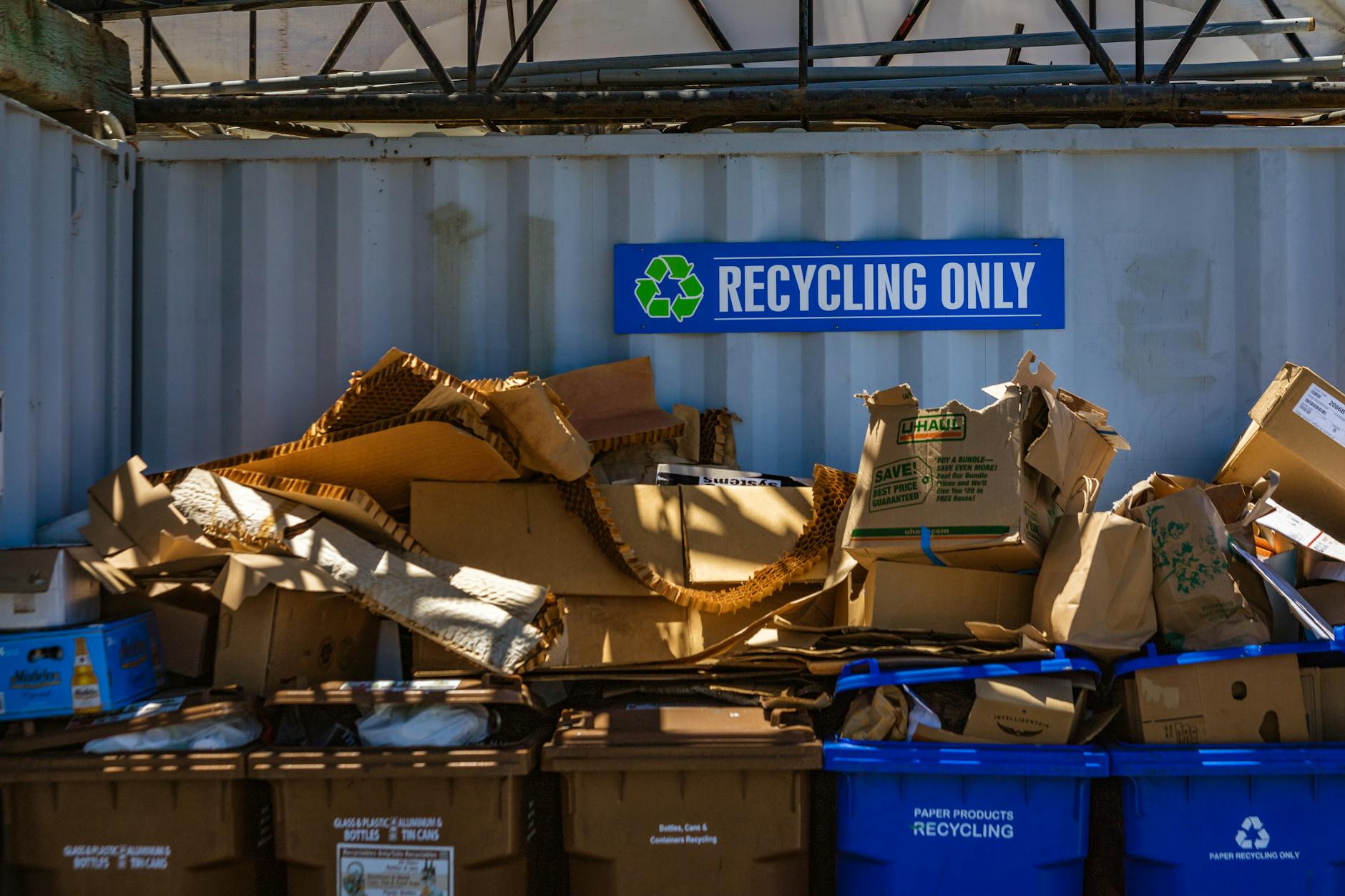
Why the waste stream is a value stream
We audit inbound freight, WIP, finished goods. Almost nobody audits the outbound segregated stream — the trash. But it is a measurable process: waste is generated (input), moved, staged, hauled (the stream), and disposed or recycled (two competing outputs). A defect in that stream is recyclable material arriving at the landfill — the same class of error as a wrong part arriving at a work cell. It fails the customer's spec (the local hauler's rules, the landfill agreement, the community's tolerance for trucked-in garbage).
Here's the Lean Six Sigma punchline that always lands when I explain it to operators: cardboard in the dumpster is not an accident, it's an output with no owner. Somewhere upstream, a person decided the box "goes to trash." Nobody attached a spec to that decision. The moment an agency or an auditor starts weighing what is in the bins, the defect rate becomes visible — and visible waste is fixable waste.
The math: what one dumpster is actually worth
Let me run a working example, the way I'd scope a project with a facilities manager. These are defensible orders of magnitude, not a quote:
Now convert that to the sigma language I use in my Waste Tax essay. Treat "a recyclable bin arriving landfilled" as a DPMO with the delivery of each hauler bin as an opportunity to sort correctly:
Say 10 bins leave a site each week, 52 bins... no — 520 bins a year. If the agency's audit flags 41 bins with banned cardboard (real-world build-out percentages), that's:
78,846 DPMO ≈ ~2.9σ — worse than a coin-flip of a well-controlled process. At 6σ that DPMO drops toward single digits, and the recovered cardboard becomes a revenue line, not a fine.
| Sigma (1.5σ shift) | DPMO | Recoverable cardboard at 40% stream share |
|---|---|---|
| 2.9σ (today, unaudited) | ~78.8k | Landfilled, and billed for the privilege |
| 4σ | ~6.2k | Diversion program starts to fund itself |
| 6σ | ~3.4 | Waste bin is a solved stream; cardboard nets positive |
The Define-phase fix
This is the same four-step arc as my Define Phase film — find where the waste lives, name it, measure it, move it. A dumpster is just the value stream's most honest BOM.
Live: where data centers are headed
- Forget Chips: These 3 Stocks Are Building the AI Data Center Boom yahoo.com
- Foes of data centers boo Shapiro’s executive order, as lawmakers cheer readingeagle.com
- Foes of data centers boo Shapiro’s data center order, as lawmakers cheer thereporteronline.com
- Politicians who once championed data centres are now bashing them | Mint livemint.com
- Eiertanz der Grünen rund um Rechenzentren profil.at
The Define Phase — film
72 seconds on where waste hides in a value stream, scored and rendered.
watch it →Grounding: Cedar Rapids Solid Waste Agency audit story (kcrg.com) and the national data-center-as-campaign-issue piece (newschannel9.com). Waste-stream share figures are representative industry orders of magnitude for office/institutional streams, not the specific Cedar Rapids tonnage — flagging it because baselines beat opinions. Data twin: waste-stream.json.